Manufacturer Assurance
"Our Two Post Parking Lift — PJS Hydraulic Stack System is engineered in Shanghai with a 1.5x safety margin, ensuring long-term structural reliability under high-frequency operation."
Compliance Support
Compliance documentation and safety configuration can be prepared according to project requirements and destination market regulations.
Two Post Parking Lift — Hydraulic Self-Locking Automated Parking System
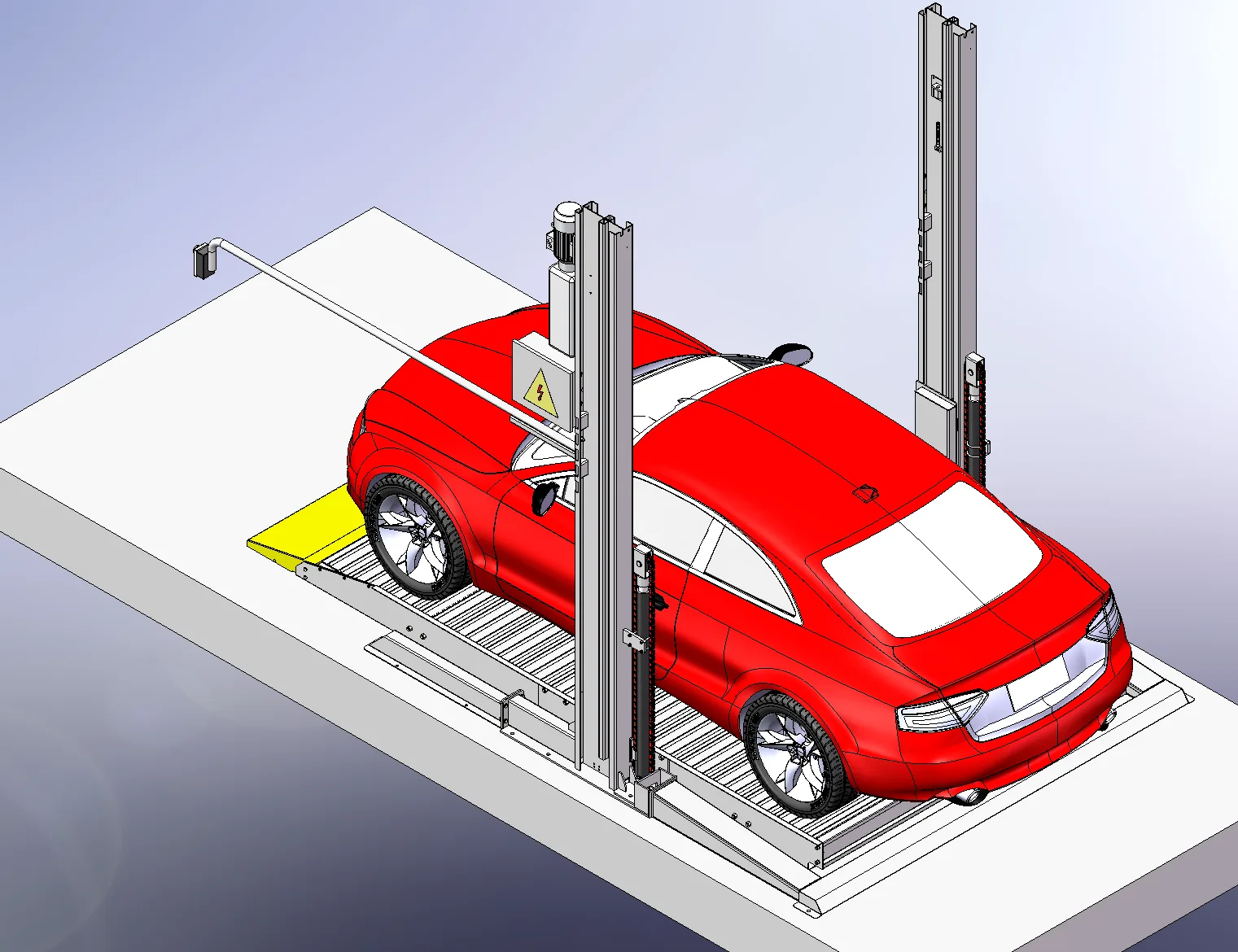
The PJS two post parking lift is the most deployed automated parking system globally — simple in concept, reliable in operation, and accessible in cost. Two vertical columns raise and lower platforms independently, parking two vehicles in the space of one. The hydraulic cylinder with self-locking check valve provides fail-safe platform retention without electronic dependency. Rated for 2,300-3,200kg per vehicle, with platform lengths up to 5,300mm accommodating most passenger vehicles including SUVs and full-size trucks. The 220V single-phase power requirement means no dedicated electrical infrastructure — standard commercial power is sufficient. Installation completes in 48-72 hours on a prepared concrete slab.
For residential, small commercial, and any site requiring 2-6 parking spaces with minimum complexity, the two post lift is the engineering-first choice.
Features — Why Choose a Two Post Parking Lift
1. Hydraulic Self-Locking Safety
Check valve technology provides mechanical self-locking — the platform holds position without any power consumption. This is fundamentally different from motor-driven systems that require electronic braking. When the hydraulic pump stops, fluid flow is blocked by the check valve, and the cylinder cannot extend or retract. This makes hydraulic self-locking the most fail-safe approach for safety-critical parking applications.
Every PJS unit also includes a mechanical anti-fall device that operates independently of the hydraulic system. Combined with overload sensors (triggering at 110% rated capacity) and photoelectric barriers at entry/exit, the system meets CE safety requirements for unattended operation.
2. 220V Single-Phase Power
The PJS two post lift operates on standard 220V single-phase power — the same as a household electric range or air conditioner. This eliminates the most common barrier to automated parking installation: electrical infrastructure upgrades. No 380V three-phase service, no dedicated transformer, no utility coordination. Most existing commercial and residential buildings have sufficient electrical capacity for 1-4 units without any upgrade work.
Power consumption during operation: 2.2-3.0 kW. Standby power: negligible. Operating cost per cycle: approximately $0.15-0.30 in electricity.
3. Rapid Installation — 48 to 72 Hours
Equipment installation completes in 2-3 days from start to operational testing. The PJS arrives pre-assembled in modular sections — the hydraulic power unit comes pre-run from the factory, minimizing on-site welding and fitting. Site requirement: a flat, level concrete slab (minimum C25 grade, 200mm thickness). No pit, no special civil works, no drainage.
Typical timeline: site preparation 1-2 weeks → equipment delivery → 48-72 hour installation → operational testing → handover.
4. Compact Footprint — 6m × 3m per Unit
Each PJS two post unit occupies a 6m × 3m = 18m2 footprint and parks 2 vehicles. Compared to surface parking at 30-36 m2 per vehicle (including drive aisle proportion), the two post lift delivers 2x land efficiency. Clear layout dimensions of 6m length enable basement and rooftop deployment in standard residential and commercial building footprints.
5. Hydraulic Cylinder Drive — Simple and Maintainable
The PJS uses a single or dual hydraulic cylinder per column, mechanically simple and proven in millions of installations worldwide. The check valve provides inherent self-locking — no electronic brake system required for the primary safety function. Chain and sprocket reduction drives the platform through a 1:50 ratio, providing smooth, controlled movement at 60-90 seconds per full lift cycle.
Maintenance intervals are predictable: annual fluid check, 3-5 year fluid replacement, hose inspection every 2-3 years. The failure mode is slow — hydraulic leakage is visible and audible before catastrophic failure, allowing planned maintenance rather than emergency repair.
6. Residential and Commercial Compatible
The PJS two post lift serves applications from single-unit residential installations to 12+ unit commercial arrays. The 220V compatibility makes it the only automated parking system that can be installed in existing residential buildings without electrical infrastructure changes. For commercial applications with higher cycle requirements, the 380V configuration provides additional power for more frequent operation.
Technical Specifications
| Parameter | Standard | Heavy-Duty | Elite (SUV) |
|---|---|---|---|
| Lifting Capacity | 2,300 kg | 2,700 kg | 3,200 kg |
| Lifting Height | 1,800 mm | 2,000 mm | 2,100 mm |
| Lifting Speed | ~60 seconds | ~75 seconds | ~90 seconds |
| Motor Power | 2.2 kW | 2.5 kW | 3.0 kW |
| Power Supply | 220V 1-Phase | 380V 3-Phase | 380V 3-Phase |
| Vehicle Dimensions | ≤5,000×1,850×1,500 mm | ≤5,200×1,900×1,550 mm | ≤5,300×1,900×1,550 mm |
| Platform Width | 2,100 mm | 2,300 mm | 2,500 mm |
| Daily Cycle Rating | 10-20 cycles/day | 15-25 cycles/day | 15-25 cycles/day |
| Installation Time | 48-72 hours | 48-72 hours | 48-72 hours |
| Self-Locking | Yes (hydraulic check valve) | Yes | Yes |
| Noise Level | 65-75 dB | 65-75 dB | 65-75 dB |
| Min. Ceiling Height | 3.2-3.6m (2-level) | 3.4-3.8m | 3.4-3.8m |
| Steel Treatment | Hot-dip galvanized Q235B | Hot-dip galvanized | Hot-dip galvanized |
Frequently Asked Questions — Two Post Parking Lift
What vehicles can a two post lift accommodate?
Two post lifts accommodate standard passenger vehicles and SUVs. Vehicle compatibility depends on platform dimensions and weight capacity of the specific model. Contact our engineering team to verify fitment for your specific vehicle fleet.
How much does a two post parking lift cost?
Equipment and installation cost varies by configuration, site conditions, and location. Contact our sales team for a site-specific quotation.
What power supply is required?
Power supply requirements depend on the specific model and configuration. Contact our team to determine the appropriate specification for your site.
How long does installation take?
Installation time depends on site preparation and system configuration. Contact our team for a project-specific timeline.
Is the two post lift safe?
The two post lift includes multiple safety systems including mechanical anti-fall devices, overload sensors, and photoelectric barriers. Safety documentation and configuration vary by target market and application.
What maintenance is required?
Regular maintenance includes periodic inspection of hydraulic systems, structural components, and safety devices. Maintenance requirements vary by usage intensity and operating environment.
Why AutoSpaceFlow PJS?
1. 3.2T Engineering Margin — Unlike standard 2.3T lifts, our Elite version handles full-size SUVs, EVs with heavy battery packs, and pickup trucks with a significant safety buffer. Rated at 3,200kg with 110% overload protection.
2. 48h CAD Layout — Send your site dimensions and ceiling height; receive a preliminary CAD configuration within 48 business hours, free of charge. Every installation is preceded by a documented engineering layout.
3. Plug & Play Modular Design — Pre-assembled hydraulic power unit, minimal on-site welding, modular column sections. Rapid installation without specialized equipment.
4. Global Voltage Support — 220V single-phase for residential markets, 380V three-phase for commercial. Configurable for 110V, 220V, 380V, 415V markets worldwide.
5. Corrosion Protection — All structural steel (Q235B columns, Q345B crossbeams) hot-dip galvanized per ISO 1461, providing 20+ years of corrosion resistance in covered garage environments.
Ideal Applications
- Residential basements with 3.6m+ ceiling height requiring 2× parking density
- Private villas with limited driveway space
- Small hotels, restaurants, and office buildings requiring 2-12 parking spaces
- Retrofit projects where civil works must be minimized
- Any site where 380V three-phase power is not available
Compare Two Post Lift to Other Systems
Not sure if two post is the right choice? Use our tools:
- Compare Two Post vs Four Post → — cycle frequency, load capacity, installation complexity
- Compare Hydraulic vs Motor+Chain → — noise, efficiency, cold weather performance
- Parking Lift vs Surface Parking → — ROI analysis, 20-year TCO
- Puzzle vs Car Stacker → — density, retrieval time, system complexity
Need a site-specific recommendation? Contact our engineering team →
Engineering Resources
- Parking Capacity Calculator → — calculate vehicles per your land dimensions
- ROI Calculator → — 20-year total cost of ownership comparison
- Parking Lift FAQ → — 12 common technical questions answered
Two Post Parking Lift — PJS Hydraulic Stack System
Custom Layout Proposal
Receive your site-specific 2D CAD layout and parking capacity review within 48 business hours from our Shanghai engineering office.
Direct Manufacturer Support • Global Export Experience